
Psychosocial Hazards in Healthcare: WHS Obligations and Where to Start
Health care and social assistance records more workers' compensation claims for mental stress than any other Australian industry, and the median payout for a psychological injury claim is more than three times that of a physical one. The WHS obligation to manage psychosocial hazards has existed for years, but most health services are still working out where to start. This page covers what you are required to do, the hazards most relevant to clinical and hospital settings, and what a realistic first response looks like.
What the law requires
Under the model Work Health and Safety Act, health services and hospitals (as PCBUs) must identify psychosocial hazards, assess the risk, implement controls, and review their effectiveness. The Safe Work Australia model Code of Practice on Managing Psychosocial Hazards at Work provides the operational framework, and applies across clinical, allied health, and support roles regardless of shift pattern or facility size.
What regulators look for is evidence that the process occurred: records of hazard identification, consultation with workers, control decisions, and review. A code-of-conduct policy or an EAP program is not evidence of that process, and it will not answer the question a WorkCover investigator or a coroner asks after a serious incident.
The 6 most common hazards in healthcare
Here are the six hazards most relevant to healthcare, each with a realistic first control and what to record. You do not need all six solved to be compliant. You need evidence that you are working through them.
Violence and aggression from patients, families and visitors
Physical and verbal aggression is one of the most consistently reported psychosocial hazards in Australian healthcare, and exposure to violence and harassment accounts for a substantial share of national mental stress claims. A first control is a documented de-escalation and reporting protocol that every shift is briefed on, with a clear point of escalation. Record: which wards or roles have an active protocol, when it was last reviewed, and whether staff have confirmed they know how to use it.
Exposure to trauma and critical incidents
Emergency, critical care, oncology and mental health staff routinely absorb trauma as part of the job: resuscitations that fail, sudden deaths, and disclosures of abuse. Under the SWA Code this sits within exposure to traumatic events, a recognised hazard requiring identification and controls, not an assumed cost of the profession. A first control is structured post-incident debrief that is scheduled, not left to whoever remembers. Record: that debrief occurred, who attended, and whether follow-up support was offered.
High job demands from patient loads and staffing shortfalls
Chronic understaffing against patient acuity is a structural psychosocial hazard, not an individual coping problem. The control is not simply hiring more staff, it is a documented process for managing demand when staffing falls below safe levels, including who makes that call and what changes as a result. A first control is a written escalation protocol for high-acuity or under-staffed shifts. Record: when the protocol was activated, what adjustments were made, and whether the outcome was reviewed with the team.
Bullying and poor support within clinical hierarchies
Bullying between senior and junior clinicians, particularly in surgical, medical training and nursing hierarchies, is well documented in the Australian literature and is a named hazard under the Code (poor workplace relationships, poor support). A first control is a clear, confidential reporting pathway that does not require the junior party to raise it with the person involved. Record: that the pathway exists, that new starters are told about it during orientation, and how reports are handled.
Shift work and fatigue
Rotating rosters, night shifts and on-call arrangements concentrate risk: reduced peer support, impaired decision-making, and isolated clinical judgement calls late at night. A first control is ensuring every night or solo shift has a named, reachable escalation contact. Record: that the contact is known to staff on that shift, and that any overnight escalation events are logged with the outcome.
Poor organisational change management
Health services are in near-constant change: new models of care, digital health system rollouts, service restructures and funding-driven reorganisation. Each change is a psychosocial hazard when it is not communicated clearly to the staff who have to run it. A first control is a brief, structured communication each time a significant change is implemented: what is changing, what is not, and who to ask. Record: that the communication occurred, when, and via what channel.
Check Your Psychosocial Records
A short set of questions on how hazards get identified, documented and reviewed today. We email you an overview of where your records stand, based on your own answers.
The simplest form of compliance is a documented conversation
A nurse unit manager who notices a graduate nurse is struggling after a difficult shift does not need a platform, a survey, or a formal incident report to begin a compliant response. They need to have a conversation and write it down.
What that looks like in practice:
That is a psychosocial consultation. It identifies a hazard, surfaces worker input, and documents a control action. It does not require a formal process to begin. It requires a habit of writing it down.
As that habit grows, covering more workers, more issues, and more consistent records, the organisation builds the evidentiary record that regulators and insurers ask for when something goes wrong.
Whichever hazard the record starts from, this is what it looks like once it has been tracked through to a closed loop:
What this looks like when it's running
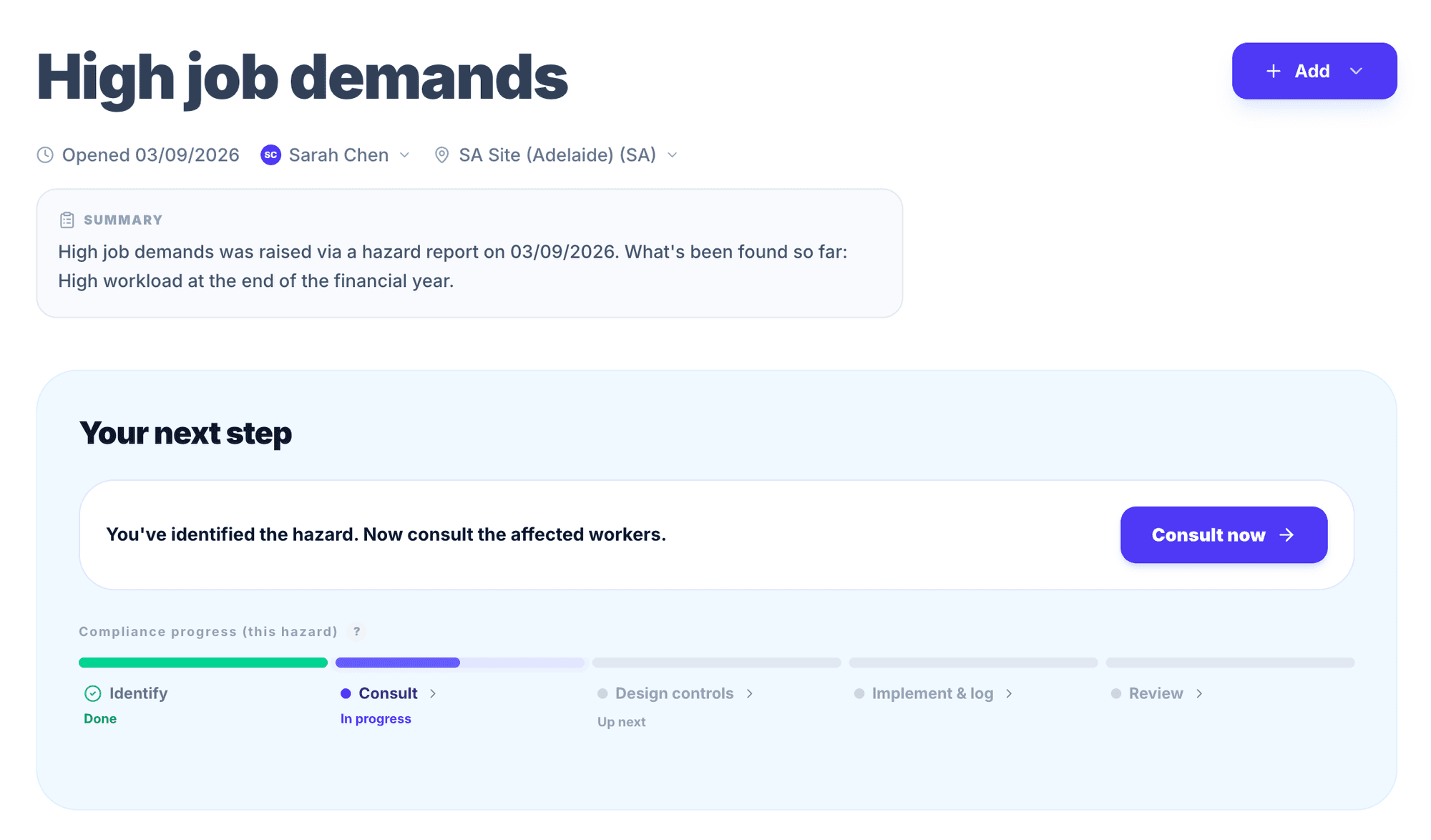
Doing this by hand works until it doesn't. Across every hazard, every worker, and every review date, the record gets hard to hold in your head. That is what PsychProof runs. It takes the same four steps, identify, consult, control, review, and keeps them as one time-stamped trail per hazard: the evidence regulators and insurers ask for when something goes wrong. Here is one hazard tracked end to end.
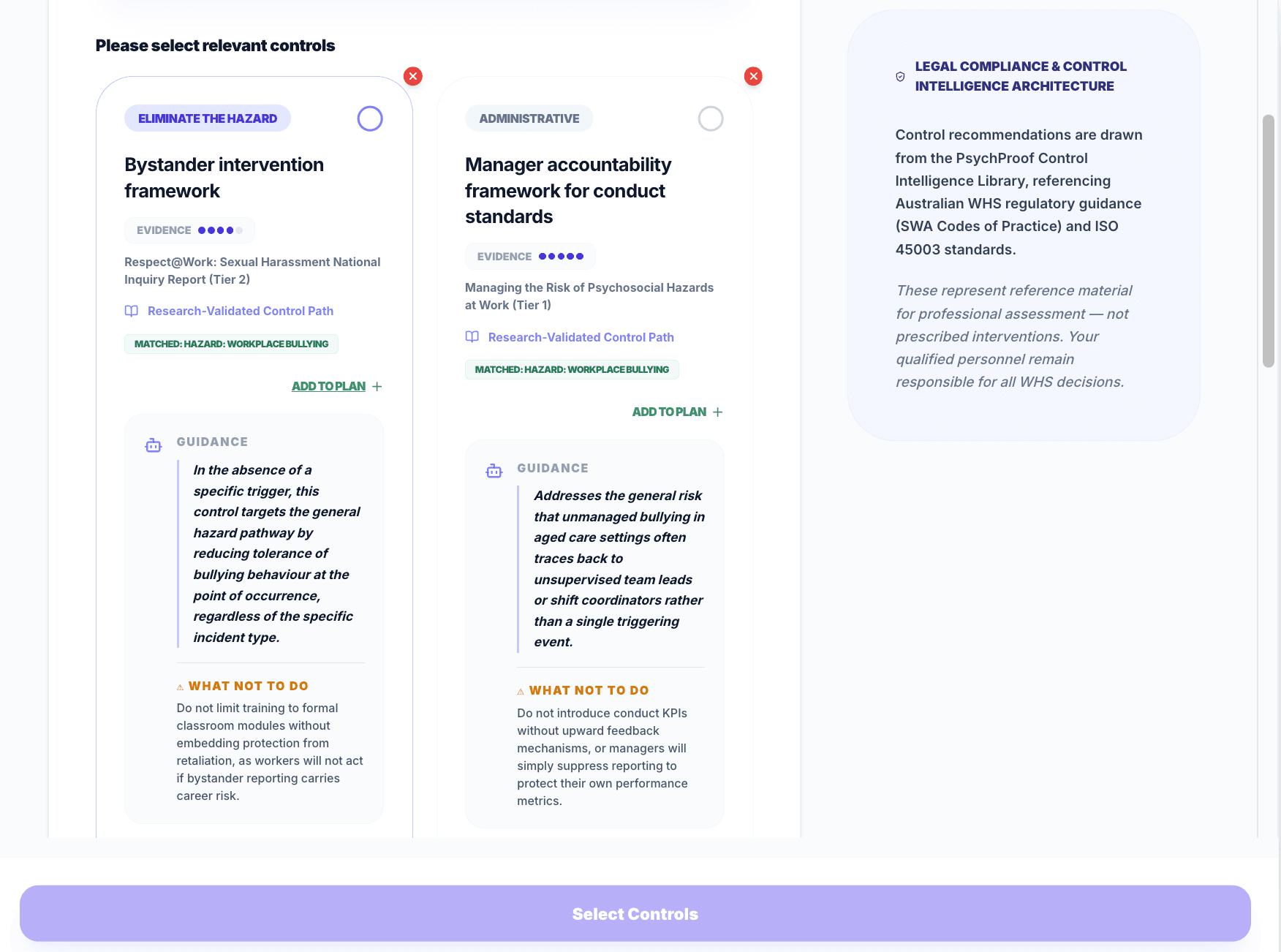
Controls aren't just chosen. They're categorised against the hierarchy, engineering and systemic before administrative, and the categorisation is part of the record.
Try our pilot programme
Pick a department, a unit, or a small team. We run PsychProof there on real hazards for six months, so you can see if it's for you, with nothing committed beyond that one team.
What to read next
Planning a restructure, AI rollout, or new system?
Change is a named psychosocial hazard in its own right. See how PsychProof assesses a change before it happens, not just the hazards it leaves behind.
Get the printable PsychProof overview
A working note on where PsychProof fits, what it does and does not do, and how the methodology adapts to your sector. Print it or send it internally.
Important Notice
This information is general in nature and provided for awareness and documentation support only. It does not constitute legal, clinical, or professional advice. Regulatory obligations vary by jurisdiction and circumstances. Organisations should refer to relevant regulators or qualified professionals for advice specific to their situation.