

Survey tools stop at identification. Incident systems start after harm. PsychProof handles the step in between.
A former WorkSafe WA inspector told us that easily 70% of the improvement notices he wrote in his record year came down to one clause: review of controls, chosen but never actually verified to have worked. Here's exactly how, walked through screen by screen, not just claimed.
Why review of controls is where it breaks down
Most organisations can show a hazard was identified. Fewer can show what was actually done about it, and almost none can show whether it worked. Three structural gaps show up again and again:
- •Controls chosen, never revisitedA control gets selected at the time a hazard is raised, then the record goes quiet. Nothing forces a return visit.
- •Success was never definedWithout a written description of what "working" looks like, a later review becomes a guess, or gets skipped entirely.
- •No independent record of the checkEven where a review happens, it often lives in someone's memory or an email thread, not a timestamped, tamper-evident record a regulator can be shown.
How PsychProof closes the loop
This is one hazard, tracked through the actual product, not a mockup. Every screen below is what a real user sees.
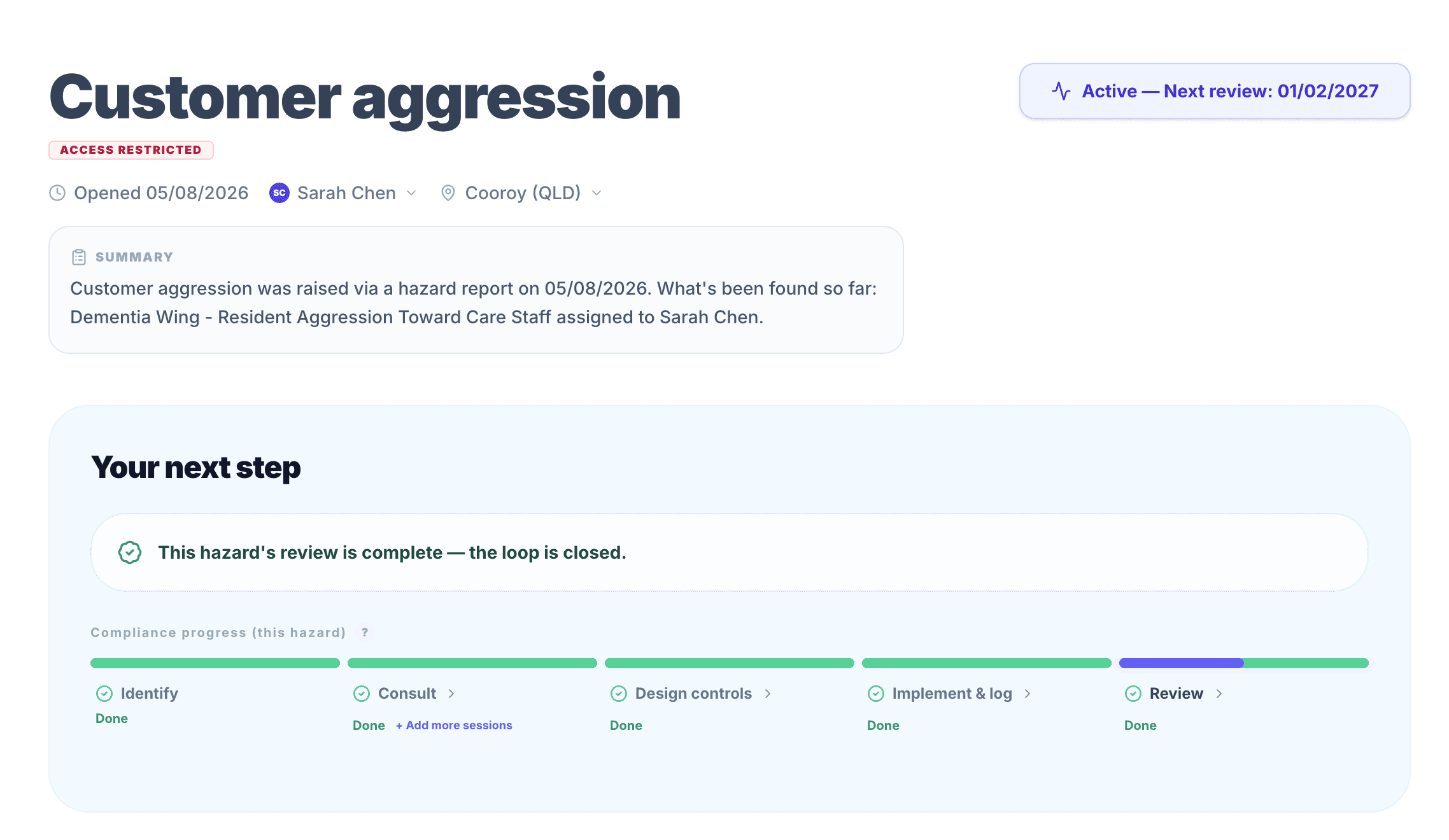
A hazard is identified and tracked as one continuous record
Identify, consult, design controls, implement and log, review, one hazard, one time-stamped trail, with the next step always visible.
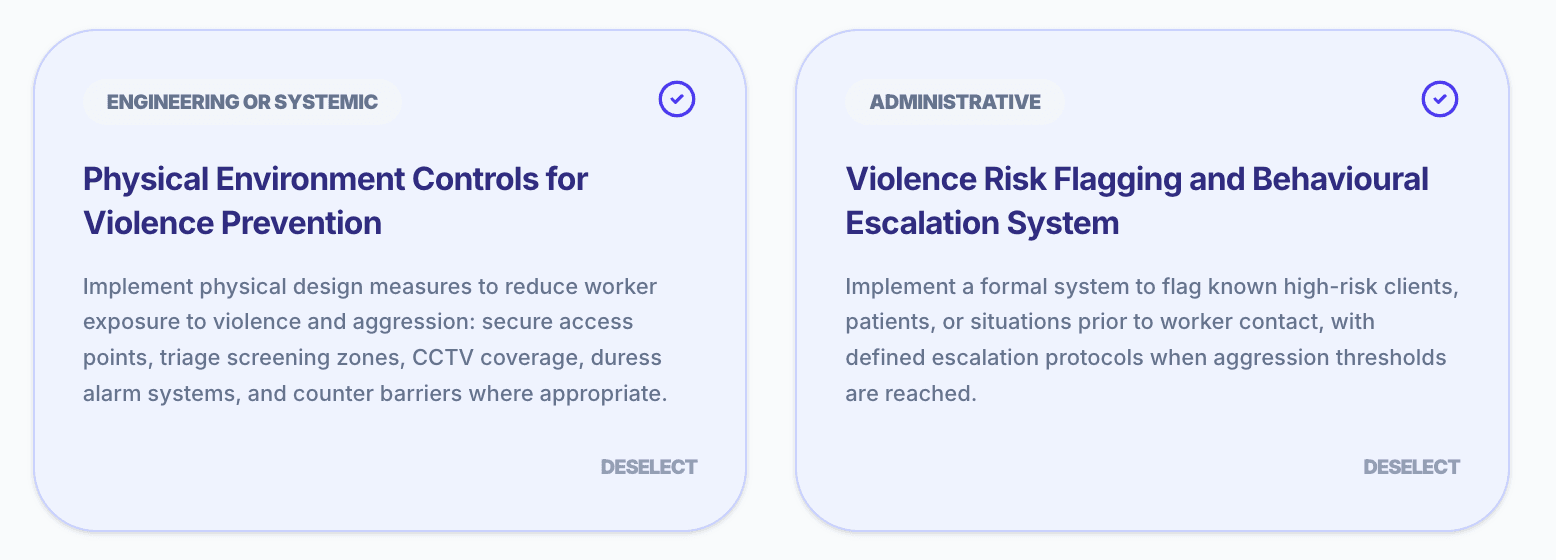
Controls are chosen, then categorised against the hierarchy, not just listed
Every control is tagged by hierarchy level, engineering and systemic before administrative, and that categorisation is part of the permanent record, not a label the user picks. In jurisdictions where the hierarchy of controls is a legal requirement, the workflow will not let you proceed past this step without either a higher-order control or a written justification of at least 20 characters for relying on a lower one. In Victoria, where information and training cannot be the sole control by regulation, the same check blocks a training-only selection outright.
Before it's locked in, you write what success and failure actually look like
A control can't be committed without a written review prompt, what will be checked, and what a pass versus a fail looks like, plus a review frequency. This is the step most systems skip entirely. PsychProof will not let a control plan advance to "locked" without it.
Review happens against that exact signal, not a fresh guess
When the review date arrives, the reviewer sees the locked review prompt and the effective/failing signal they defined back at step 3, side by side, and makes an explicit call: Effective or Failing. Not a status that quietly ages, a decision, made against a standard set in advance.
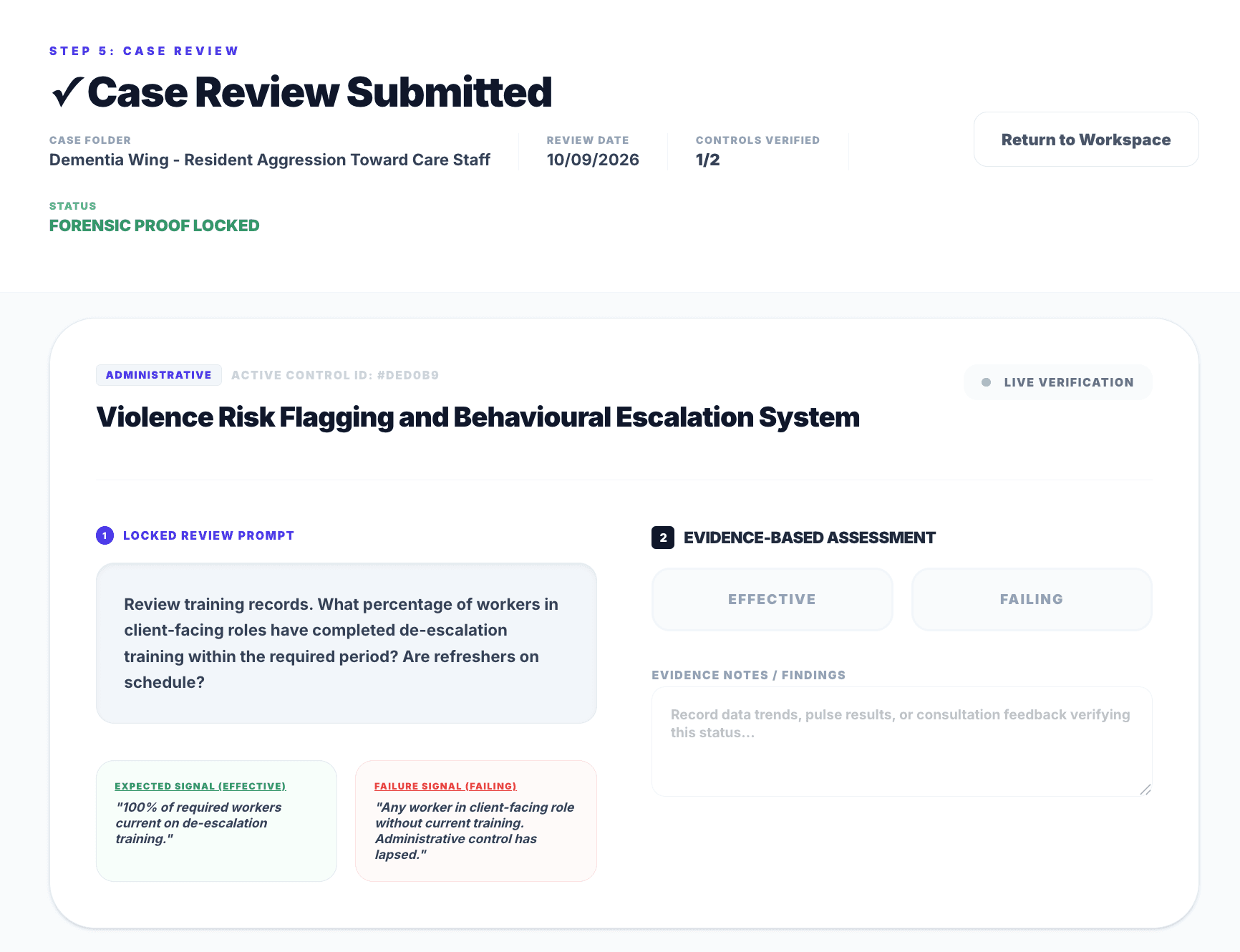
What "Effective" or "Failing" actually does
Marked Effective
The outcome is written to a dedicated review record for that specific control, RFC 3161 timestamped, then appended to the company's immutable audit log. Never overwritten, only ever added to.
Marked Failing
Same permanent record, same timestamp, but in a jurisdiction where the hierarchy of controls is mandatory, marking a control as failing triggers an explicit escalation prompt in the workflow itself. A failing control does not just sit there quietly.
Every review, and every case status change that follows it, generates its own timeline entry and audit event, tied to the reviewer's name, role and timestamp. The next review date is set automatically. That's the difference between a system that lets you record a review and one that structurally will not let a control plan reach "done" without one.
Why this is the step regulators actually enforce on
Identifying a psychosocial hazard is the easier half of the duty. Demonstrating that a chosen control was actually reviewed, and what that review found, is where most documentation runs out. That's consistent with what a former WorkSafe WA inspector described to us: the clause his improvement notices came back to most often wasn't a missed hazard, it was an unreviewed control.
PsychProof is built specifically for that step. Not a replacement for a survey tool, and not a replacement for an incident system, the record that sits between them.
Disclaimer: PsychProof provides structured digital documentation systems designed to support review of psychosocial risk controls. PsychProof does not provide legal advice, nor does the use of the software guarantee compliance with Work Health and Safety laws or protection from legal action. The responsibility for ensuring that workplace practices and documentation legally discharge WHS duties remains entirely with the customer and their legal counsel.
Important Notice
This information is general in nature and provided for awareness and documentation support only. It does not constitute legal, clinical, or professional advice. Regulatory obligations vary by jurisdiction and circumstances. Organisations should refer to relevant regulators or qualified professionals for advice specific to their situation.