

The instrument that sits upstream
A risk assessment that leads to a control, not a filing cabinet.
Run before there's a specific problem, not after. A scoped, evidence-based psychosocial risk assessment: every hazard is checked for completeness before you move on, every recommendation is ranked and cited, and the result hands off directly into an owned control with a review date.
Guided, or run it your way
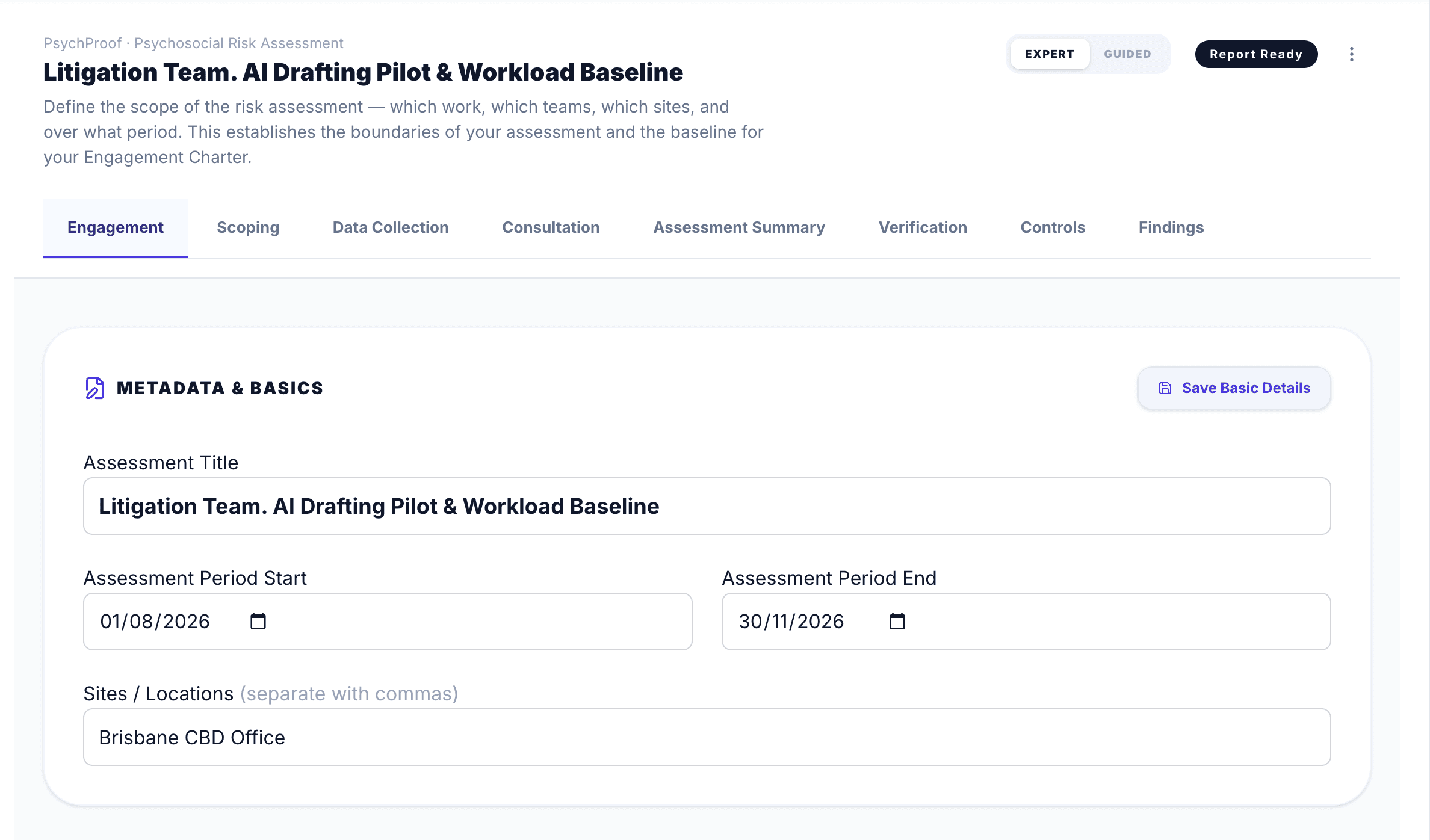
Every assessment is Engagement, Scoping, Data Collection, Consultation, Summary, Verification, Controls, Findings — in that order.
Switch to Guided mode and it walks you through one sub-step at a time, so nothing gets skipped by accident. Already know your way around it? Switch to Expert mode and work the same eight stages directly, at your own pace.
How it works
Four stages, each one gating the next.
Scope it before you assess it
Organisation, work structure, employment relationship, period and locations, what's in scope and what isn't, all defined upfront. In Guided mode it's one question per screen, with a live progress bar, so the assessment has a boundary instead of drifting.
Evidence, not a single self-rating
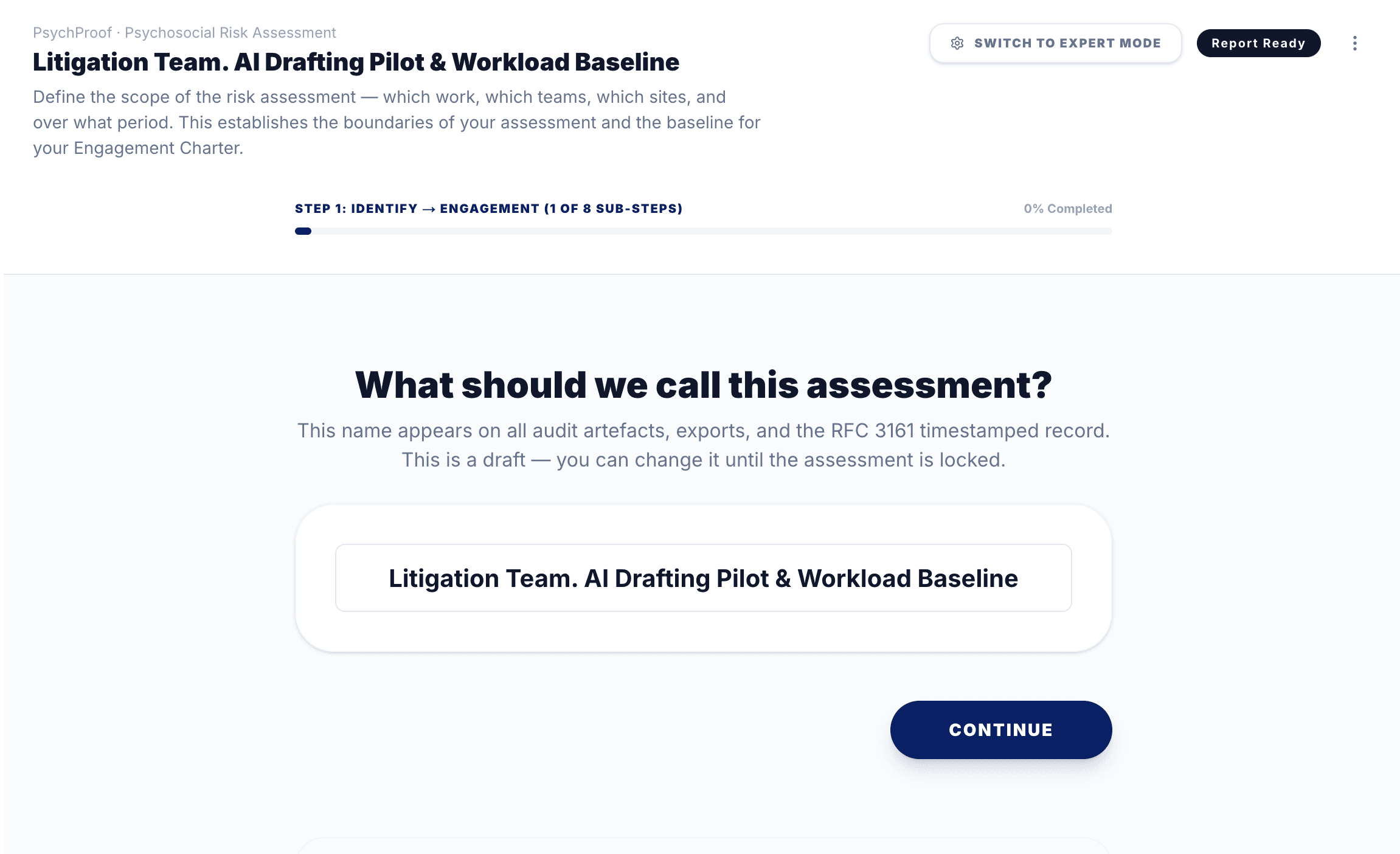
Each hazard is built from the evidence you record against it, not one 1-5 number filled in once. As consultation notes come in, PsychProof surfaces hazards it can already see in what you've logged, each one tied back to exactly who said what. A completeness check won't let you move to controls while a hazard is left unassessed.
Recommendations, ranked and cited
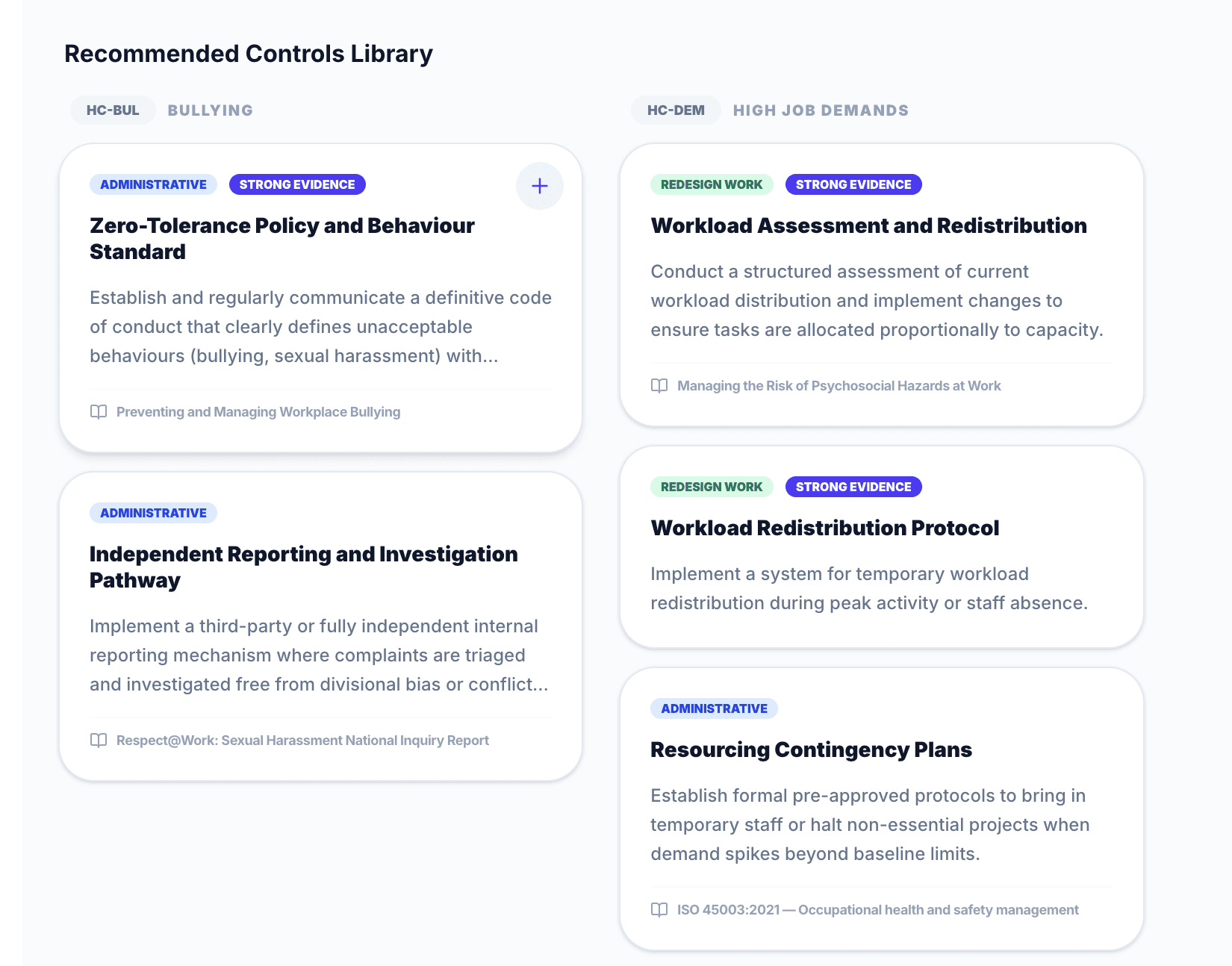
Suggested controls are tagged by control type, ranked on the same hierarchy of controls used across PsychProof, and, where the evidence is strong, marked as such, with the source cited underneath, not a generic best-practice line.
Feeds straight into the record
A finding doesn't end the assessment. It becomes an owned control with a review date in the same place, so the assessment leads somewhere instead of sitting in a report.
Definition matters
A risk assessment runs before you know there's a specific problem. If something's already happening, that's a different workflow.
Risk Assessment (this page)
Proactive and upstream. Scheduled or comprehensive, run across a team, site, or the whole organisation to find what could go wrong before it does, the way you'd run one ahead of a restructure or a new operating model.
Signals & Cases (elsewhere in PsychProof)
Reactive and incident-triggered. A department already under strain, a concern someone's raised, a notice that's landed, these get logged and managed as a Signal or Case, not folded into a risk assessment that was never meant to carry them.
Consultation is a continuous legal obligation, before, during and after, not a survey you send once. And when a matter reaches a commissioner, whether you looked after this and can prove it is the whole question, evidence is what actually decides outcomes, which is why every hazard here carries its source, not just its score.
Why it's different
Most tools stop at the score. This one won't let you.
A survey-based tool gives you a number per hazard and calls it an assessment. PsychProof treats that number as the start of the record, not the end of it, and it's built to stop a gap from quietly slipping through.
What most tools do
- One score per hazard, self-rated once
- A heat map, then a PDF
- Recommendations as generic text
- Nothing stops an incomplete assessment
What PsychProof does
- Evidence recorded per hazard, checked for completeness
- A control plan with owners and review dates
- Recommendations ranked and cited to their source
- Can't move to controls while a hazard is unassessed